Showing posts with label Pakistan: Pharma News. Show all posts

Sunday, 26 February 2012

Drug Regulatory Agency Ordinance Pakistan (DRAOP) - 2012, The Drugs Act 1976 and the 18th amendment in The Constitution of Pakistan 1973


My Opinion:
If you visit Government of Pakistan's official site at www.pakistan.gov.pk, and try to find Ministry of health or Division of health under the tab of ministries & division then you will be unable to find this!
Why?
because in Pakistan Ministry of Health doesn't exist on federal level
Why it doesn't exist?
because due to 18th amendment in constitution of Pakistan, federal legislative list has been changed. Due to which alongwith various ministries health ministry was also devolved from federal level to provincial level.

Federal ministry was devolved but according to the article 270 AA (6) of the constitution of pakistan 1973, all related laws are in force. this article is reproduced as:

“Notwithstanding the omission of the Concurrent Legislative List by the Constitution (18th Amendment) Act, 2010, all laws with respect to any of the matters enumerated in the said list (including ordinances, orders, rules, by-laws, regulations and notifications and other legal instruments having the force of law) in force in Pakistan or any part thereof, or having extra-territorial operation, immediately before the commencement of the Constitution (18th Amendment) Act, 2010, shall continue to remain in force until altered, repealed or amended by the competent authority.”


This Point advocates that Federal government can use his powers confered to him via section 12 of The Drugs Act 1976, to increase the maximum price of drugs. It is apparently legal to increase the price of drugs
but, it equally invalidate the development of new Drug Regulatory Authority - 2012. Because If section 12 of The Drugs Act 1976 is functional then section 5 (Central Licensing Board) and section 7 (Registration of Drug) will also be functional. If all laws are in force then the development of DRA is questionable.


Furthermore, amendment in The Drugs Act 1976, is required if federal government wants DRA to be functional.


Read More at :
http://kamranzaheer.blogspot.com/2012/02/drug-regulatory-agency-of-pakistan.html


Daily Jang Karachi, February 16, 2012


20% to 100% rise in price of 350 medicines

16 February, 2012 
http://paktribune.com/news/20-to-100-rise-in-price-of-350-medicines-247575.html

KARACHI: The 'non-functional' Ministry of Health has allowed local and multinational drug manufacturing companies to increase prices of different medicines by 20 to 100 percent.
According to sources close to the pharmaceutical industry, permission has been granted to increase prices of about 350 medicines while a decision about the rest will be taken in the next meeting.
The first meeting of the board to allow an increase in prices was held in Islamabad on February 8 in which the price of cough syrups of all categories was increased by 100 percent. A packet of Disprin containing 600 tablets will now cost Rs130 more; the price of a packet of Librex with 20 tablets has been increased by Rs20; the price of a packet of Panadol with 200 tablets has been increased by Rs40; and a packet of Trisil, having 500 tablets, will cost Rs110 more.
The price of Fastum Gel has been increased by Rs117 and it will be now available for Rs207 instead of its previous price of Rs140. Somogel has become costlier by Rs19. The price of Ceporex capsules too has been increased from 20 to 100 percent. Prices of antibiotics and diabetes medicines have also been increased. In all, prices of about 300 medicines have been raised.
It is learnt that in the next meeting, two more lengthy lists will be considered. It may be clarified that the officials of the Ministry of Health had stated that with reference to drug regulation, the ministry is non-functional and hence not in a position to implement the regulation. However, it is ironic that in order to take a decision against the interest of the common man, not only has the non-functional ministry become functional but has taken a vital decision of raising the prices of medicines even before the establishment of the regulatory authority.



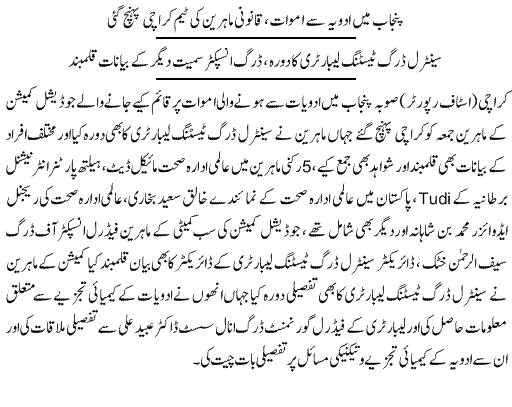
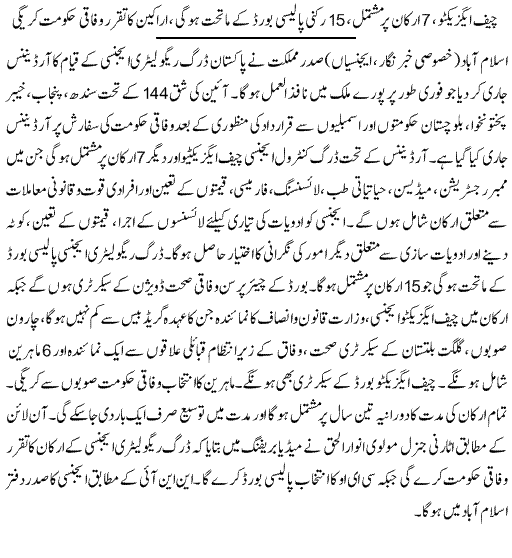
DRA - 2012 Pakistan: When it will be functional?


Visit my blog at: http://kamranzaheer.blogspot.com/2012/02/drug-regulatory-agency-of-pakistan.html
where i tried to address the same issue!


Daily Express Karachi, Saturday February 25, 2012


Daily Jang Karachi, Wednesday, February 22, 2012


Saturday, 25 February 2012

Sind government signed a MoU with IHP (International Health Partner) an NGO of UK, to supply medicine worth $2 million each year for Five years!!!!!


KARACHI: 
The medical superintendents of all major government hospitals are going to form a cell that will put together a list of all medication the province needs, said Health Minister Dr Sagheer Ahmed.

On Monday, he signed an agreement with British NGO International Health Partners (IHP) for a five-year plan to supply stock worth $2 million each year.
Previously, the IGP was working with the government of the Punjab that got four million dollars in medicines last year. “In view of the floods which affected millions, the IHP has already contributed about five million dollars to Sindh but this MoU, which kicks off from the upcoming financial year, is independent of that,” said IHP president Anthony Dunnett.
“Pakistan has been a close friend and our (IHP) patron, the Prince of Wales, has shown sincere concern for the region especially after the monsoon floods,” Dunnett said. He hoped to strengthen their support to the health department in time to come.
The money saved through the initiative can be used to help achieve the country’s millennium development goals. “It is a crime that women and children’s needs are not met and we are grateful for the opportunity to help provide the right medicines to the right people at the right time.”
The medicines will be sent in two bunches – one for the humanitarian cause which would be supplied to the World Health Organisation (WHO) and the other to the health departments.
WHO representative in Pakistan Dr Guido Sabatineui called the initiative “a tripartite agreement” and said that the continued commitment of the government was important. According to Sabatineui, 50 per cent of the $10 million donated for the flood was distributed in Sindh where the need was currently the greatest. Sabatineui explained that the WHO’s role involved logistical management of the medicines as well as ensuring the terms of agreement, with special stress on transparency, were enforced.
IHP Pharmacist Trudi Hilton said medicines currently required were mostly antibiotics, for oral rehydration and anti-malarials.
Published in The Express Tribune, February 22nd, 2011.


Trudi Hilton is the same, who has been called by the government of Punjab for assistance on PIC drug issue

Friday, 17 February 2012

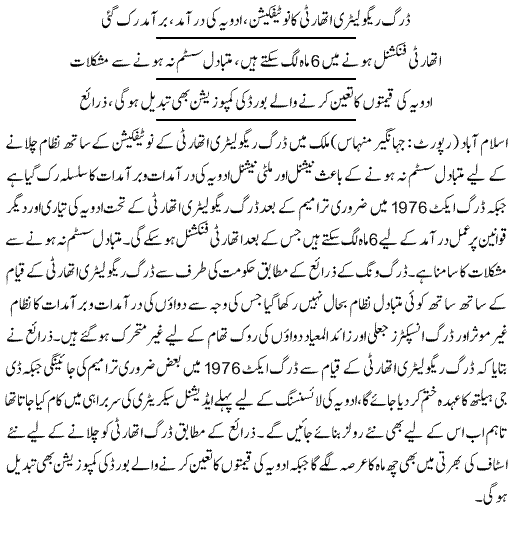
Drug Regulatory Agency of Pakistan (2012) : Ordinance Issued

Ordinance of Drug Regulatory Agency Pakistan

Daily Express Karachi, February 18, 2012

Daily Jang Karachi, February 17, 2012 (online edition)


Daily Jang Karachi, February 16, 2012


Daily Jang Karachi, February 16, 2012


Daily Jang Karachi, February 16, 2012


Daily Jang Karachi, February 7, 2012


18th amendment, in the constitution of Pakistan was unanimously passed in National Assembly of Pakistan. According to this mighty amendment several ministries was either dissolved or merged at federal level, whereas, some ministries was completely handed over to provinces. It took a long time to formulate the procedure for this transfer. Ministry of Health was among the last ministries to be transferred to provinces.
From July 1, 2011, Ministry of health was supposed to be controlled by provincial governments. Unfortunately, the pathetic political tussle and conflict of interest between federal and provincial bureaucracy, literally left ministries of health paralyzed. Specially, the matters of  Drug Registration and Manufacturing Licenses, and their renewal was made unnecessarily complicated and thus suspended, by some officials of federal government and pharma sector representatives.

In this scenario Supreme Court asked government to formulate a federal drug regulatory authority by February 17, 2012. On February 17, 2012 President of Pakistan issued  Drug Regulatory Authority Ordinance (DRAO) 2012.


Was it necessary to issue this ordinance?


  • Section 5 of the Drug Act 1976 deals with regulating the manufacture of drugs by the central licensing board, set up by  the federal government.

  • Section 12 of the Drug Act 1976, deals with the power of federal government to fix maximum prices of drug.

  • Section 7 of the Drug Act 1976 deals with regulating the registration of drugs by the registration board, set up by  the federal government.


Both of these boards are protected by article 270 AA (6) which deals with the declaration and continuance of the law. The law is reproduced as below:

“Notwithstanding the omission of the Concurrent Legislative List by the Constitution (18th Amendment) Act, 2010, all laws with respect to any of the matters enumerated in the said list (including ordinances, orders, rules, by-laws, regulations and notifications and other legal instruments having the force of law) in force in Pakistan or any part thereof, or having extra-territorial operation, immediately before the commencement of the Constitution (18th Amendment) Act, 2010, shall continue to remain in force until altered, repealed or amended by the competent authority.”

This clause clearly says that any law in force will continue to remain in force till the new law is altered, repealed or amended by the competent authority.


It is the need of the hour to remove any deficiency in the central licensing board and registration board, so that the vacuum, which has created confusion and is hindering the implementation of Drugs Act 1976, may be filled.
There is not much need to make new laws every now and then. Rather there is a dire need to implement the Drugs Act 1976 and abide by the constitution in letter and in spirit.


Bibiliography: http://www.dawn.com/2012/02/18/drug-control-authority-some-facts.html


Fate of an Ordinance


Article 89 of the constitution of Pakistan after 18th amendment (2010) states that an ordinance will be repealed (obsolete) at the expiration of 120 days from its promulgation (implementation). If that ordinance is to be continued then it should be laid before the National Assembly and get it passed. National Assembly may by a resolution extend the Ordinance for a further period of one hundred and twenty days; that extension for further period may be made only once.

Federal government has to laid this ordinance in the parliament before June 17, 2012 or the ordinance be repealed. Alternatively, government may further extend this ordinance for further 120 days. (Maximum time till October 17, 2012)

During May and June 2012, Federal government is expected to present but, and during budget session no other bill could be laid before national assembly. 
As rumours and stance of government shows that somewhere in October national assembly is going to be dissolved for next general election, then at that moment DRAP will repealed automatically. If there was no national assembly in october then the senate will be the only forum to approve that ordinance as bill, otherwise another vaccum will likely to be occur regarding Drug Regulatory authority in october 2012.


Note: A lawyer by profession may address the said issue better,( and I'll wellcome it!)


My Opinion !!!!!!!
Kamran Zaheer
kamranzaheer.blogspot.com

Wednesday, 15 February 2012

How could Pakistan become self reliant in Pharmaceutical Sector

Khalil Ahmed nani taal wala is well known figure in the pharma circle. Medicam and Touchme etc are his own brands. He is also the owner of Woodward's and Chas A medosa (pharmaceuticals)
In the following columns he shares his views about Drug Act and highlighted the need of self reliance in pharma sector.


Daily Jang Karachi, September 25, 2011.


Daily Jang Karachi, February 12, 2012


My Opinion:
I agree with most of the things, which Mr. Nanital wala has discussed in his column.
But I  urge to upgrade our National Pharmaceutical Companies so that, they be in compliance with the standards laid down by WHO and FDA. Because no one will raise the fingers about the quality of our medicines then.

Its time for the owners of Pakistan based Pharmaceutical companies to pay the cost of quality. Investment in terms of hiring qualified pharmacists in your companies will surely boost your revenue and profit.


Kamran Zaheer
kamranzaheer.blogspot.com


Monday, 13 February 2012

Findings of Inquiry Committee on Isotab 20 reaction


Punjab Institute of Cardiology


The findings of the inquiry committee headed by DIG Zulfiqar Cheema have recommended registration of a murder case against 10 officials, including the owner of the Karachi-based Efroze Chemical Industry, for criminal negligence resulting in contamination of one of its medicines, which claimed the lives of nearly 150 cardiac patients registered with Punjab Institute of Cardiology (PIC), Lahore. 

The inquiry report of a three-member committee, headed by DIG Zulfiqar Cheema and comprising SSP Zulfiqar Hameed and SSP Farooq Mazhar, available with The News, also recommended action under various sections of Pakistan Penal Code and Drug Act 1976 against two officials of distributing company, Umer Trading Company, and five officials/doctors of PIC for tempering record of delivery and receipt of the tainted medicine to the PIC. 

The action has been recommended against 10 officials including 


  1. Muhammad Abdullah Feroze (owner)
  2. Nadir Feroze (deputy managing director)
  3. Khurram Munaf (director technical)
  4. Shakeel Ahmad Khan (general manager plant)
  5. Muhammad Imtiaz (quality control manager)
  6. Tabish Naumani (production executive)
  7. Syed Waqas Hussain (supply chain executive)
  8. Syed Iftikhar Ahmad (store officer)
  9. Syed Razi Haider Kazmi (helper)
  10. Muhammad Shoaib Ansari (helper) of Efroze Chemical Industry 


under Sections 322, 302 of PPC and 23/27 of Drug Act 1976. 

The inquiry committee has also recommended action against the two distributors (owners of Umer Trading Company) including Muhammad Musharraf and Tariq Rehman under Section 322 of PPC and 23/27 of Drug Act. 

Moreover, around five doctors/officials of PIC have also been held responsible for tempering record of batch of contaminated medicine including Muhammad Yousaf (pharmacist/store in charge), Zulfiqar Ali (storekeeper) and members of Inspection of Medicines Committee including Dr Abdul Hameed (AMS Store), Dr Ali Hasan (DMS Store) and Dr Ameer Ali (DMS admn), who signed the document, under Sections 420, 467, 468, 471 of PPC. 

The committee has submitted the inquiry report to the IG Punjab, Javed Iqbal with recommendation of strict compliance with the findings to punish the culprits as well as to set a deterrence for all multinational and local pharmaceutical companies to avoid such unfortunate incidents in future by providing quality medicines to the patients without any discrimination. 

Earlier, the committee has found that the pharmaceutical company had been manufacturing two different drugs - Isotab (blood-thinning medicine) and Maladar (anti-malaria medicine containing Pyrimethamine) - simultaneously, which caused contamination up to 14 times in Isotab-20, which were supplied to the PIC and ultimately caused deaths of at least 120 heart patients registered with the hospital. 

It found that the officials of pharmaceutical company didn’t follow the pre and post manufacturing standard operating procedures including the rules set under Pakistan’s law and Good Manufacturing Practices (GMP), Current Good Manufacturing Practices (CGMP) and World Health Organisation. 

The company’s production unit had identified the contamination of Pyrimethamine in Isotab on September 21, 2011, and this information was passed on to the owners on September 29, 2011. On October 4, 2011, GM Plant Shakeel Ahmad Khan had also e-mailed to the owners that a container of Pyrimethamine weighing 25 kg was missing but no action had been taken in this regard. It is also worth mentioning that the raw material of Pyrimethamine was taken from the store without proper requisition. 

Senior Quality Control Officer Fayyaz told inquiry committee that an unusual spike was detected during the post-manufacturing test, but still the batch of medicine was cleared by the management and distributed but was never recalled from the hospital or market shelves. The matter, however, was hushed up through an internal inquiry of the company. 

The committee observed that the pharmaceutical company had ignored the standard operating procedures in manufacturing of the medicine owing to provision of this medicine to PIC at very cheap rate as compared to market price of Rs 20 per tablet. 

The distributing company supplied a consignment of 2 million tablets of Isotab to PIC on October 8, 2011 vide challan No. 462 on which batch No. J092 and J095 were printed, whereas the afore-mentioned pharmaceutical company had provided the medicines to the distributors under batch Nos. J091, J092, J093, J094, J095 and J096 vide invoice No. 49969 on September 30, 2011 and another invoice No. 50039 dated October 4, 2011. These medicines were received at PIC by storekeeper Zulfiqar on October 8, 2011 and also entered into stock registered on October 10, 2011 but omitted batch No. J093. 

The committee also noted that there were several other batches of different medicines, which were neither registered nor their examination was conducted by the Drug Testing Laboratory before distributing to the patients. 


http://www.thenews.com.pk/TodaysPrintDetail.aspx?ID=12412&Cat=13

Sunday, 12 February 2012

Special report in Jang Karachi: General Information for general public and insight for Pharmacists


This report opens various horizons!

have a look!

After reading this report, some issues are needed to  be addressed on urgent basis.
Like

  • Is it true that in a tablet active and excipient ratio is around 1:5.
  • why products of Multinational companies (MNCs) are far expensive than the Pakistani National Pharmaceutical ones
  • what is DRA?
  • Influence of Multinational pharmaceutical companies in Pakistan
  • How prices of drugs are controlled
  • what is the rationale, when a patient is advised to take half tablet?
I'll try my level best to address these issues in my future blogs. in sha ALLAH.

Thursday, 9 February 2012

Drug Testing Laboratries: Soldiers without Swords!!!

An overlooked side

During the ongoing tragedy that cost 100+ valuable lives of poor patients, so far, due to the consumption of adulterated and sub-standard drugs at Punjab Institute of Cardiology,  blame game for political point scoring is at its peak. Drug regulatory authorities found themselves in hot water about their performance and their capabilities. In search of scape goat, Drug inspectors and Assistant Drug Controllers emerged as sitting ducks. Almost everyone, after reading some news stories, and after watching some news alerts is setting up his own court and passing his verdict that it is due to the criminal negligence of drug inspectors.

Everyone has right to keep his own opinion; but no one should blame others without knowing fact and having sound evidences.

After reading the following report that was published in Daily Express Karachi - Saturday, February 4, 2012 a radical change may occur in your stance.


Importance of a Functional Drug Testing Laboratory

Whenever a drug inspector takes a sample of drug for the purpose of testing or analysis he is bound to send a portion of sample to the government analyst of concerned drug testing laboratory under clause (i) of sub section (3) of Section (19) of the Drugs Act 1976.

Under sub section(1) of Section (22) of The Drugs Act, Government analyst deliver a copy of his report to the drug inspector.


and what is the worth of this report???????


sub section (4) of section (22) states


".........any document purporting to be a report signed by a Government analyst shall be admissible as evidence of the facts stated therein without formal proof and such evidence shall be conclusive......."


that's why the report of drug analyst is the most important part of a inspector's prosecution in a drug court.


Those who are allergic to too much references of laws, I present a summary,
" After taking a sample of suspected drugs, inspector will analyze that from a govt. analyst, whose report shall be treated as evidence and sometimes conclusive"


Conclusion

In the absence of a functional drug testing laboratory, a drug inspector will be unable to prosecute properly in case of adulterated, substandard, spurious and misbranded drug. This in turn encourages the culprit opportunists.

It is a matter of grave concern, indeed a matter of life and death in our Pakistan where the presence of spurious drugs in the market is a known problem. The federal and provincial governments must upgrade their drug testing labs to international standards.


Regards

Kamran Zaheer
kamranzaheer.blogspot.com

Note: I am not advocating concerned govt. officials, instead i am trying to draw your kind attention towards an overlooked angle.

Sunday, 5 February 2012

Advertisement of Clopidogrel in Newspapers: Is it legal or not?


This advertisement was published on Sunday, February 5, 2012 in The Daily Jang Karachi on Page. No.2.


A question may arise in minds of some pharmacists and general public that, whether that ad. is legal or not, because advertisement in any open source media definitely promotes self medication.


My view is that this advertisement is legal, because its only informing the patients about the availability and price of PLAVIX (Clopidogrel) 75mg. 

It doesn't contain anything like Indication, Class of Drug, Dosing frequency etc therefore it is useless for general public and self medication freaks.


Now have a look what The Drugs Act 1976 says about this,


Sub Rule (4) of Rule (31) of The Drugs (Licensing, Registration and Advertisement) Rules, 1976 states:


"A drug or any substance referred to in clause (ii) of Section 24, may be advertised through Press without reference to the Federal Government if it is merely intended to inform the public of the availability or the price of such drug or any substance referred to in clause (ii) of Section 24 subject to the condition that the Federal Government may prohibit such advertisement if, in its opinion, the public interest so requires."


Now have a look on what is mentioned in clause (ii) of Section 24 of The Drugs Act, 1976.


"any substance used or prepared for use in accordance with the ayurvedic, unani, homoeopathic or biochemic system of treatment or any other substance or mixture of substances as may be prescribed;"


You can google for the complete text of :
The Drugs Act, 1976
The Drugs (Licensing, Registration and Advertisement) Rules, 1976


or you can visit my previous blogs to see their complete text
kamranzaheer.blogspot.com


Regards 


Note: I am not advocating Sanofi - Aventis in any respect, I just wrote this blog for the awareness of Pharmacist.

Pharmaceutical sector of Pakistan, GMP compliance, Efroze Pharma and India as MFN (Most Favourite Nation)


In the recent past, Government of Pakistan has decided to declare India as MFN (Most Favourite Nation) i.e,  articles imported from India will be charged minimal or no import duty. Serious concerns over this issue were raised and are still need to be address properly as how the domestic industries will be protected. 


Now read this :
Isotab may have been a  contaminated pill but drug manufacturers say the route from factory’s conveyor  belt to patients’ medicine cabinets is a long one 

Punjab Chief Minister Shahbaz Sharif : a batch of Isotab tablets, meant for heart patients, had been contaminated with an anti-malarial chemical,

Pakistan Pharmaceutical Manufacturers Association (PPMA) claimed:  the real culprit is the lack of a drug regulatory authority. Even if the company manufactured faulty medicine, what were the drug inspectors and the managers at the Punjab Institute of Cardiology doing after the drugs were distributed, he said.
Sindh health secretary, Syed Hashim Raza Zaidi said : As a standard practice, the provincial health department always sends medicines for tests at the laboratory whenever they are bought in large quantities for public sector hospitals.
Cost of panic
Panic over a batch of contaminated medicine threatens to upend a multi-million dollar industry. Economist Arshad Zaman says it poses a serious damage to “Pakistan as a brand” in the global market.
“There are over 400 [pharmaceutical] companies [in Pakistan],” said vice chairman for PPMA Tariq Ikram. “Each company produces an average of 100 products. Millions of units are produced. This is just one company and one product. Such instances happen once in a lifetime and the entire industry’s image should not be damaged because of it,” he said.
The association chairman said contaminated drugs and their recall is a global phenomenon that has affected giants like GlaxoSmithKline and Johnson & Johnson.
Heparin, an anti-coagulant was recalled in March 2008 after a contaminated batch imported from China killed 81 people in the US.
Earlier, Tylenol, a popular American painkiller manufactured by Johnson & Johnson killed seven in 1982 before the product was recalled across the United States.

But panic is spreading fast. The mounting death toll in Punjab and reports from a laboratory in London stating Efroze Pharmaceutical’s IsoTab contained high dosage of anti-malarial pyrimethamine, have led to at least five countries banning cardiology medicines from Pakistan, PPMA says.
Pakistan’s pharmaceutical industry has an estimated worth of $200 million, exports $100 million worth of medicines to over 60 countries, and an annual growth rate of around 30%, said Khawaja.
All that may be on the stake because of a single contaminated batch.
“For decades people have been taking Pakistani medicines and now one dispatch after another is being stopped,” says former PPMA chairman Kaiser Waheed. “The cancellations and bans have started but it will be six months before we can accurately quantify the impact.”
Waheed also defended the company, Efroze Pharmaceutical, which he said has been in the industry for around half a century and exports to 27 countries. “They are a well-known family in the business. They are known as the ‘dawai walas’ because their forefathers were in the business in Calcutta before partition,” he said.

Published in The Express Tribune, February 3rd, 2012.


Editorial of Daily Express February 4, 2012
A really good one


Pharma sector is one of the fast growing sector who is earning foreign exchange for Pakistan for last two decades.  Pharma sector and regulatory authorities of Pakistan were in a debate whether to allow the import of medicine from India or not. ( Although we are already importing APIs (Active Pharmaceutical Ingredients) mainly from China and India.) 

One group is of the opinion that Pharmaceutical Plants in Pakistan, especially National ones are not producing quality medicines which are less effective, therefore, medicines be imported from India which will not only be of superior quality but cost effective too. 

The other group states that if Indian medicines are permitted to import into Pakistan then it would be the last straw on camel's back, as Pharma sector is already facing challenges due to energy crisis as well as apparent corruption in regulatory affairs, and increasing prices of API and excipients. This decision if taken will be a heavy blow for National Pharma as they won't be able to compete the Indian medicines in terms of price, because India do not have to import API and they get subsidies too. This group entrusts the quality of medicine manufactured by Pakistani Pharma.

Here arises a question that whether Pakistani Pharma are capable enough to produce quality medicine, if yes then why Prescribers and health allied professionals dont see eye to eye on the matter of quality medicines.
How we come to know that Medicines and Medicinal Products produced by a particular Pharmaceutical company are of utmost quality or not.

Answer lies in the compliance of GMP (Good Manufacturing Practices)
What is GMP?
GMP is a is a set of practices that gives guidance relating the different aspects of Production and testing that can have a impact on the quality of a product.  Ultimate goals of these guidelines are safeguarding the health of the patient as well as producing good quality medicine, medical devices or active pharmaceutical products. 

Our Drug regulatory authorities are statutorily responsible to make every Pharmaceutical Plant in Pakistan  to operate in compliance with GMP.

In simple words any Pharmaceutical Plant who is certified to be in compliance with GMPs is automatically considered to produce quality medicines

Considering the recent tragedy happened at PIC Lahore, and following the Locking and Sealing of Efroze Chemicals  in Karachi, GMP certified Pharmaceutical Plants are now the need of hour. GMP compliance is the key of prosperity for the Pakistani Pharmaceutical Sector

Who is in compliance with GMP and who is not, I don't know!

I know only that without a qualified pharmacist GMP compliance will remain a dream. Quality has its cost, and for Owners of Pharmaceutical Plants its time to pay this cost!

For those who are blaming  Pakistani Pharmaceutical Plants I must quote someone else words
" We Pharmacist and other people working in Pharmaceutical Plants don't go to Pharmaceutical industry, early in the morning and returns home at night, in order to produce medicines that kill people."

Kamran Zaheer